About the Author
This article is brought to you by the expert team at Invogue Building Systems, a trusted name in industrial and commercial construction across India. With years of hands-on experience in designing and delivering steel structures, PEB sheds, warehouses, and factory buildings, the Invogue team combines deep engineering knowledge with a practical understanding of what businesses actually need on the ground. From initial site assessment to final structural handover, every project at Invogue is driven by a commitment to safety, quality, and compliance — not just speed or cost. The team regularly shares insights, industry guidance, and practical advice through this blog to help business owners, project managers, and investors make smarter, more informed decisions when it comes to industrial construction. If you have a project in mind or simply want to understand your options better, the Invogue Building Systems team is always happy to have a straightforward conversation — no sales pressure, just honest expertise.
Why This Matters for Your Business
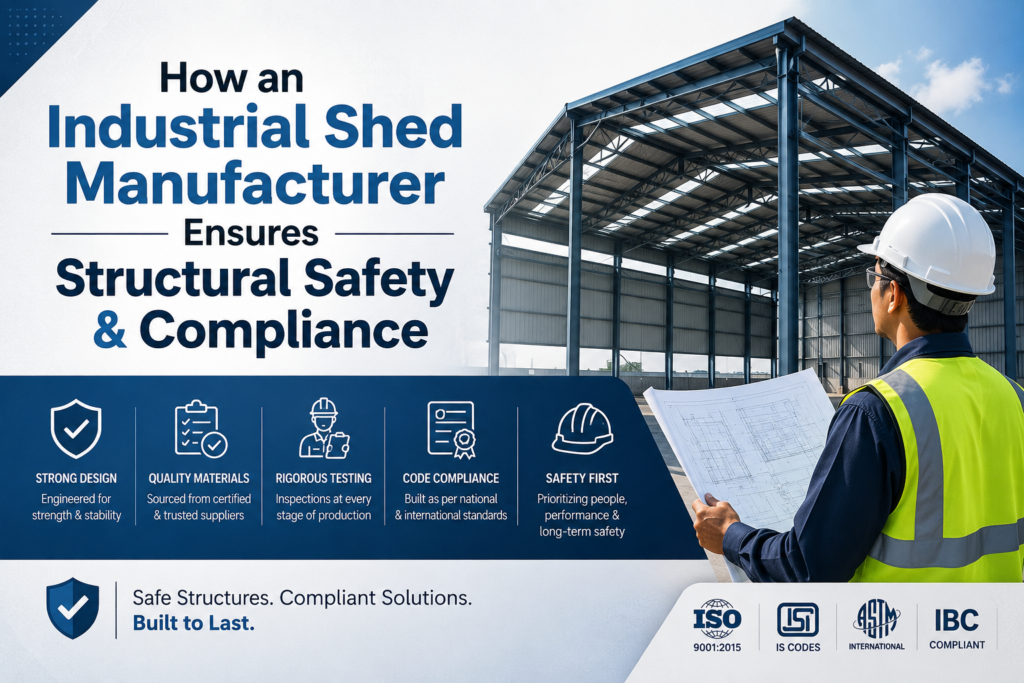
A reliable industrial shed manufacturer ensures structural safety through engineering-grade design, code-compliant materials, load testing, and certified construction practices — from the foundation to the roofline. Read on to understand exactly how this works and what to look for.
Introduction: More Than Just Four Walls and a Roof
Imagine this — a business owner in Maharashtra commissions a large storage shed for heavy machinery. The structure looks solid on day one. But within a year, the roof starts sagging after a heavy monsoon, wall panels warp under summer heat, and the floor cracks under load. The culprit? A manufacturer who cut corners on structural engineering and compliance.
This is not a rare story. In India’s fast-growing industrial landscape, structural failures from poorly built sheds cost businesses lakhs in losses, equipment damage, and operational downtime — not to mention serious safety risks for workers.
At Invogue Building Systems, we believe that every industrial shed must be built to last, not just built fast. As a responsible industrial shed manufacturer, we follow a detailed, compliance-first approach to every project — from initial design to final handover.
In this blog, we break down exactly how a professional Industrial Shed Manufacturer ensures structural safety and regulatory compliance, step by step.
What Does “Structural Safety” Actually Mean for Industrial Sheds?
Structural safety in industrial construction refers to a building’s ability to withstand the forces it will face throughout its lifetime — dead loads (its own weight), live loads (people, equipment, inventory), wind forces, seismic activity, thermal expansion, and more.
For an industrial shed, this is especially critical because these structures often house heavy machinery, chemicals, vehicles, or large workforces. A structural failure isn’t just expensive — it can be catastrophic.
Key Structural Safety Parameters
| Safety Parameter | What It Means | Why It Matters |
| Dead Load Capacity | Structural self-weight support | Prevents gradual sagging or collapse |
| Live Load Tolerance | Weight of people, inventory, equipment | Ensures floor and mezzanines don’t fail under use |
| Wind Load Resistance | Ability to withstand wind pressure | Critical in coastal or open industrial zones |
| Seismic Resistance | Stability during earthquakes | Mandatory in seismic zones II–V across India |
| Thermal Movement Allowance | Expansion joints for heat/cold cycles | Prevents cracking and warping over time |
| Foundation Integrity | Soil bearing & base design | The root of all structural stability |
Core structural safety parameters every industrial shed manufacturer must account for during design and engineering.
Compliance Standards Every Industrial Shed Must Meet
In India, industrial construction is governed by a set of national and state-level standards. A professional industrial shed manufacturer doesn’t just know these — they build every project around them.
Applicable Indian Standards & Codes
| Standard / Code | Governing Body | What It Covers |
| IS 800:2007 | BIS (Bureau of Indian Standards) | General construction in steel |
| IS 1893 | BIS | Earthquake-resistant design criteria |
| IS 875 (Parts 1–5) | BIS | Design loads for buildings (wind, snow, live) |
| NBC 2016 | Ministry of Housing & Urban Affairs | National Building Code — general construction norms |
| Factory Act / Local Bye-Laws | State Governments | Occupational safety, ventilation, fire exits |
| IS 2062 | BIS | Steel quality grades for structural use |
Key compliance standards that a professional industrial shed manufacturer must adhere to in India.
At Invogue Building Systems, every project begins with a compliance mapping exercise — identifying which codes apply based on location, usage, and zone classification, before a single drawing is made.
Step-by-Step: How We Ensure Safety from Start to Finish
Here’s a transparent look at the process a responsible industrial shed manufacturer like Invogue Building Systems follows to guarantee structural safety and compliance on every project.
Site Assessment & Soil Testing — Before any design begins, a geotechnical survey is conducted. Soil bearing capacity, groundwater levels, and site topography all directly impact foundation design and column spacing.
Structural Design by Certified Engineers — Our in-house engineers use software like STAAD.Pro and SAP2000 to model the structure, simulate load conditions, and optimize member sizing — ensuring no guesswork enters the design.
Material Selection & Quality Assurance — We use IS 2062-grade structural steel, high-tensile roofing sheets, and corrosion-resistant coatings. Every batch is tested before fabrication begins.
Third-Party Drawing Approval — Structural drawings are submitted to local authorities or a licensed structural consultant for review and approval before construction begins.
Fabrication with Precision — All steel members are fabricated in our controlled factory environment with CNC cutting, welding by certified welders, and dimensional checks at each stage.
On-Site Erection & Inspection — A dedicated site supervisor monitors each phase of erection. Bolted connections, anchor bolts, purlin spacing, and bracing systems are all checked against the approved drawing.
Final Inspection & Handover Documentation — Before handover, a final structural audit is conducted. Clients receive as-built drawings, material certificates, and a compliance checklist.
What Sets a Safety-Focused Industrial Shed Manufacturer Apart?
Not every industrial shed manufacturer operates with the same commitment to safety. Here’s a comparison of what distinguishes a compliance-first manufacturer from one that doesn’t prioritize safety:
Safety-First vs. Cut-Corner Manufacturer
| Feature | Safety-First Manufacturer | Cut-Corner Manufacturer |
| Engineering | Certified structural engineers, software-based design | Rule-of-thumb estimates, no formal analysis |
| Material Quality | IS 2062-grade certified steel | Unverified or secondary-grade material |
| Code Compliance | IS 800, IS 875, NBC 2016 followed strictly | Codes ignored or partially followed |
| Soil Testing | Mandatory for every project | Skipped to save cost/time |
| Welding Standards | Certified welders, NDT testing | Unqualified labour, no inspection |
| Documentation | Full as-built drawings, test certificates | Minimal or no documentation |
| Warranty | Structural warranty provided | No warranty or vague verbal assurances |
Comparison between a safety-focused and a cost-cutting industrial shed manufacturer — choose wisely before signing any contract.
Tips for Buyers: What to Ask Your Industrial Shed Manufacturer
Whether you’re building a warehouse, factory, or logistics hub, here are practical tips to ensure you’re working with a manufacturer who takes safety seriously:
- Ask for structural calculation reports — Any credible industrial shed manufacturer should be able to show you engineering calculations, not just sketches.
- Request material test certificates — Steel grade, yield strength, and coating thickness should be documented.
- Check the engineer’s credentials — Is there a licensed structural engineer signing off on the drawings?
- Clarify the wind and seismic zone design — Your shed must be designed for the specific zone it will be located in.
- Ask for references from past industrial projects — Visit or speak to previous clients to verify the quality of finished work.
- Ensure proper fire safety provisions — Exit widths, fire doors, and sprinkler provisions should be part of the plan, not an afterthought.
- Get a structural warranty in writing — A manufacturer confident in their work will back it with a written warranty.
Pro Tip: Always insist on a pre-construction meeting with the manufacturer’s structural engineer — not just a sales representative. This single step can save you from months of problems later.
Do’s and Don’ts When Hiring an Industrial Shed Manufacturer
Quick Reference: Do’s & Don’ts Checklist
| Category | Do This | Avoid This |
| Verification | Verify certifications, licenses & GST registration | Hire based only on the lowest price |
| Design | Request engineered drawings before any advance payment | Accept verbal assurances without documentation |
| Materials | Insist on ISI-marked and tested materials | Allow substitution of materials without written approval |
| Site Work | Get soil test reports before finalising foundation design | Skip geotechnical investigation to save money |
| Compliance | Ensure local building permits are obtained | Begin construction without approved drawings |
| Inspection | Appoint an independent supervisor or consultant | Leave all inspection only to the contractor |
| Handover | Ask for as-built drawings and maintenance manual | Accept handover without complete documentation |
A practical do’s and don’ts checklist for anyone working with an industrial shed manufacturer — save this before your next project meeting.
Common Mistakes Buyers Make (And How to Avoid Them)
Warning: These mistakes are among the most common reasons industrial shed projects fail, get delayed, or become safety liabilities.
- Choosing price over quality: A lower quote often means lower-grade steel, fewer anchor bolts, or skipped wind bracing. The savings evaporate quickly when repairs begin.
- Not specifying usage loads upfront: If you plan to store 10-tonne machinery but the shed is designed for 3-tonne live loads, you’re setting up a structural failure.
- Ignoring local building codes: Every state in India has specific building bye-laws. Non-compliance can result in demolition orders or operational shutdowns.
- Skipping foundation design: Many buyers focus on the superstructure (walls, roof) but neglect the foundation. A weak foundation undermines everything built above it.
- No fire safety planning: Industrial sheds often store flammable materials. Fire exit widths, extinguisher provisions, and fire-rated panels are not optional.
Frequently Asked Questions
Q. How do I know if an industrial shed manufacturer is following safety codes?
Ask for structural design drawings stamped by a licensed engineer, material test certificates, and approval from the local municipal or industrial authority. Compliance is always documentable — if a manufacturer can’t provide paperwork, that’s a red flag.
Q. What is the minimum steel grade required for industrial shed construction in India?
As per IS 2062, structural steel used in industrial construction should be of Grade E250 or higher. Pre-engineered building systems (PEB) often use high-strength grades like E350 or E410 for primary members.
Q. How long does it take to get an industrial shed approved and constructed?
Timelines vary by size and location. Typically, design and approvals take 2–6 weeks, fabrication takes 4–8 weeks, and erection on-site takes 2–6 weeks. A full project can range from 2 to 5 months depending on complexity.
Q. What is the difference between a PEB shed and a conventional industrial shed?
A Pre-Engineered Building (PEB) is designed and fabricated entirely in a factory and assembled on site — making it faster, lighter, and often more cost-effective. Conventional sheds use general steel sections and are designed project-by-project. Both can meet safety standards when done right.
Q. Does an industrial shed require a building permit?
Yes, in most cases. Industrial sheds above a certain floor area (which varies by state) require building plan approval from the local authority, factory plan approval (under the Factories Act), and sometimes environmental clearances. Skipping this is illegal and risky.
Q. How does Invogue Building Systems ensure compliance on every project?
Invogue Building Systems uses a compliance-first methodology: every project goes through site assessment, engineering by certified professionals, material QA checks, authority approvals, and a final structural audit before handover — with full documentation at every step.
Q: How Much Does It Cost to Build an Industrial Shed?
The cost of building an industrial shed in India generally ranges from ₹800 to ₹2,500+ per square foot, depending on the size, design complexity, materials used, and location of the project. A basic steel structure with standard roofing will sit at the lower end of that range, while a fully engineered PEB shed with insulation, mezzanine floors, crane provisions, and fire safety systems will naturally cost more. Other factors that influence the final price include the steel grade and sheet thickness, local labour rates, transportation costs, and whether the site falls in a high wind or seismic zone — both of which require additional bracing and reinforcement. As a rough benchmark, a 5,000 sq. ft. basic industrial shed may cost between ₹40–60 lakhs, while a premium engineered facility of the same size could go up to ₹1.2 crore or more. Always ask your industrial shed manufacturer for a detailed, itemised quote — a reliable manufacturer will never hand you a vague lump-sum figure without clearly breaking down what you’re paying for.
Q: Can I Run a Business Out of a Shed in My Backyard?
Yes, in many cases you can — but whether it’s legally permissible depends on your local zoning regulations, the nature of your business, and the type of structure you build. Residential plots in India are typically classified under residential land-use zones, and running a commercial or manufacturing operation from such a plot may require a Change of Land Use (CLU) approval from your local municipal authority. Low-impact businesses like a small workshop, storage unit, or home-based production setup are more likely to get the green light than operations involving heavy machinery, significant noise, chemical storage, or large volumes of foot traffic. It’s also worth noting that even backyard sheds above a certain size — usually 20 to 30 square metres, though this varies by state — require building plan approval before construction begins. If you plan to employ workers inside the shed, certain provisions of the Factories Act or the Shops and Establishments Act may also apply. The bottom line is that a backyard shed can absolutely support a small business, but it’s always worth checking with your local municipal body or a legal consultant before you start building, to avoid penalties or demolition notices down the line.
Q: What Are the Best Questions to Ask an Industrial Shed Manufacturer?
Before you sign any contract, there are a few questions that every buyer should ask their industrial shed manufacturer — and the answers will tell you a great deal about who you’re dealing with. Start by asking whether their structural drawings are prepared and stamped by a licensed structural engineer, because this is non-negotiable for any safe and compliant build. Ask specifically which steel grades and roofing sheet specifications they plan to use, and request confirmation that the materials meet IS 2062 standards. It’s equally important to ask which building codes the design will comply with — a credible manufacturer should reference IS 800, IS 875, IS 1893, and the National Building Code 2016 without hesitation. Request references from similar past projects and, if possible, ask to visit a completed site. Before work begins, clarify who will be supervising the erection on-site and what their qualifications are, since on-site supervision quality has a direct impact on structural integrity. Ask what the structural warranty covers and get it in writing — a typical warranty ranges from 5 to 15 years depending on the steel grade and protective coatings used. Finally, make sure you understand what the final handover package includes; at minimum, you should receive as-built drawings, material test certificates, a maintenance guide, and a full compliance checklist. A manufacturer who answers all of these questions confidently and transparently is one worth trusting with your project.
Conclusion: Safety Is Not Optional — It’s the Foundation
Structural safety and code compliance are not boxes to tick — they are the foundation on which every successful industrial shed stands, quite literally. From the soil under your foundation to the bolt at your roof ridge, every element of a well-built industrial shed is backed by engineering, testing, and compliance with national standards.
When you choose an experienced industrial shed manufacturer, you’re not just buying steel and sheets — you’re investing in a structure that will protect your people, your assets, and your business for decades.
At Invogue Building Systems, safety and compliance are embedded in every stage of our process. We don’t cut corners because we understand that the true cost of a structural failure far outweighs any savings made during construction.
At Invogue Building Systems, safety and compliance are embedded in every stage of our process. We don’t cut corners because we understand that the true cost of a structural failure far outweighs any savings made during construction.
Ready to Build Safe & Smart?
Talk to the Invogue Building Systems team today. We’ll walk you through a safety-first approach tailored to your project — no jargon, no pressure, just honest expertise.