Picture this: you’ve finally got the land, the funding, and the green light to build your warehouse or factory shed. Everyone tells you “just go with a contractor,” but a friend in the industry warns you — traditional construction can take 8 to 12 months, run over budget, and still leave you with a structure that isn’t built for your actual load or usage needs. Sound familiar?
This is exactly why more businesses across India — from logistics companies to cold chain operators — are turning to Pre-Engineered Buildings (PEB) instead of conventional construction. But here’s the catch: your entire project’s success depends on one decision — choosing the right PEB manufacturer.
In this guide, we’ll break down what PEB really means, why the manufacturer you choose matters more than people realize, and how to pick one that won’t leave you with delays, rusting sheets, or a structure that can’t handle a monsoon. Whether you’re building a warehouse, a factory shed, or a temperature-controlled cold storage unit, this article will help you make an informed decision.
What is a PEB Manufacturer, and Why Does It Matter?
A PEB Manufacturer is a company that designs, fabricates, and supplies pre-engineered steel structures — buildings where the main framework (columns, rafters, purlins) is manufactured in a factory and then transported to your site for assembly. Unlike traditional brick-and-cement construction, PEB structures are engineered using software that calculates the exact steel sections needed based on your building’s span, height, roof slope, and load requirements (wind, seismic, snow, etc.).
Here’s the simple version: instead of building everything from scratch on-site, a PEB manufacturer builds the “skeleton” and skin of your structure in a controlled factory environment, then ships it to you for quick on-site erection. Think of it like ordering a modular, made-to-measure suit instead of stitching one from raw fabric at home — faster, more precise, and far less wastage.
Why does the manufacturer matter so much? Because two companies can both claim to build “PEB structures,” but the quality of steel, the accuracy of design software, the coating on the sheets, and the erection team’s experience can vary drastically. A good PEB manufacturer in India will factor in your local climate, soil conditions, and usage (warehouse vs. cold storage vs. factory shed) — a bad one will hand you a generic template and move on.
Where PEB Structures Are Commonly Used
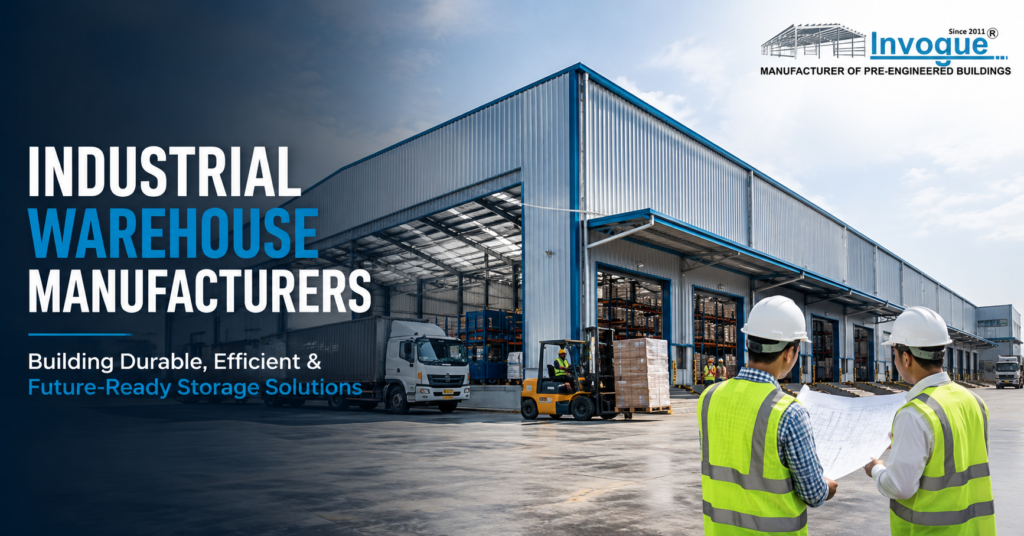
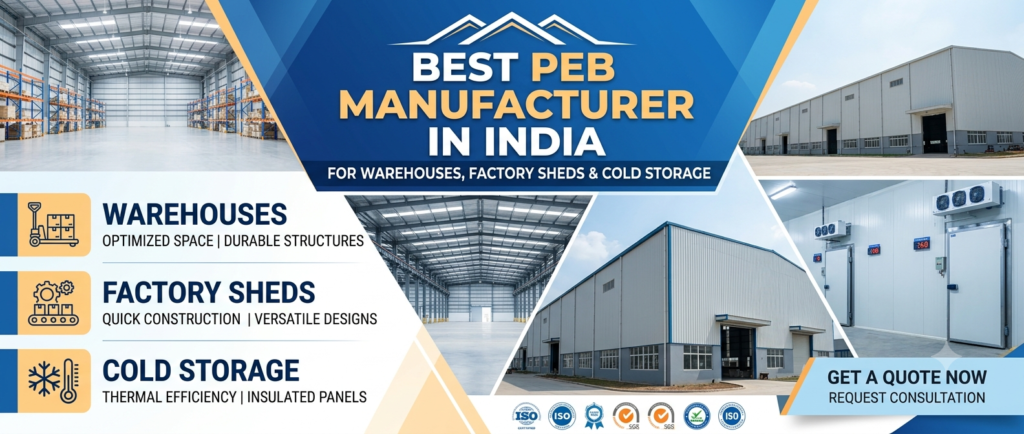
- Warehouses — large clear-span storage facilities for logistics and e-commerce
- Factory sheds — manufacturing units, assembly lines, workshops
- Cold storage units — insulated structures for perishables, pharma, and food storage
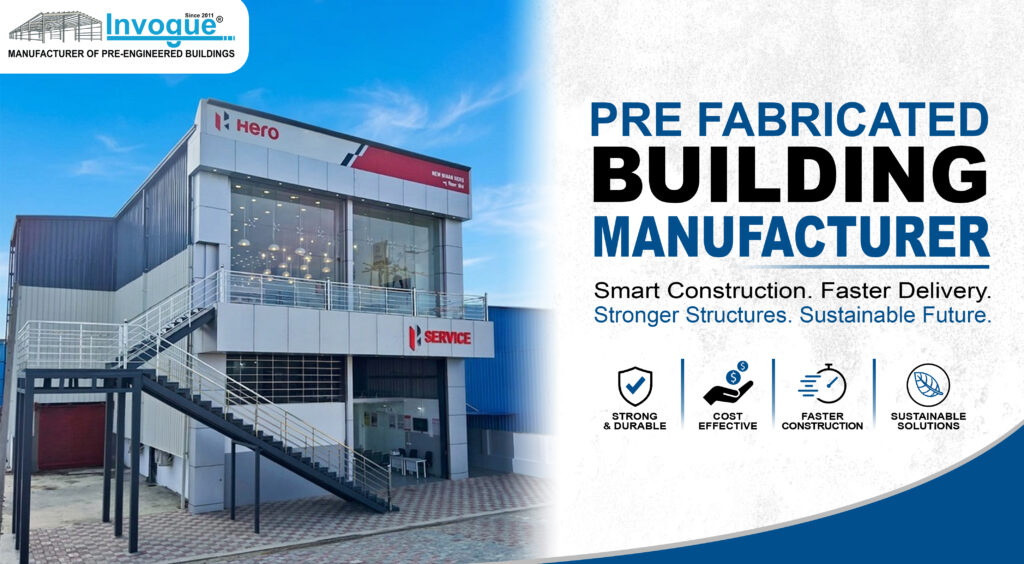
- Commercial buildings — showrooms, multi-storey structures, sports complexes
- Agricultural structures — rice mills, godowns, and grain storage
Key Benefits of Choosing a Reliable PEB Manufacturer
Let’s get into why businesses are increasingly choosing PEB over conventional construction — and what a dependable manufacturer actually brings to the table.
Feature & Benefit Overview
| What It Is | Why It Matters |
| Factory-fabricated steel components | Consistent quality control, fewer on-site errors, precise dimensions |
| Faster construction timeline | Reduces project time by up to 50% compared to conventional construction |
| Large clear-span design | No internal columns — ideal for warehouses needing open floor space |
| Customizable insulation (PUF panels) | Essential for cold storage and temperature-sensitive facilities |
| Lower long-term maintenance | Corrosion-resistant coatings mean fewer repairs over the years |
| Design flexibility | Structures can be expanded or modified as your business grows |
Note: Actual benefits vary depending on the manufacturer’s engineering capability, steel quality, and project management practices.
Warehouses vs. Factory Sheds vs. Cold Storage: How PEB Requirements Differ
Not every PEB structure is built the same way. A warehouse storing packaged goods has very different requirements from a cold storage unit holding frozen food. Here’s a quick side-by-side look at how the design priorities shift.
Application-Wise Comparison Table
| Structure Type | Primary Requirement | Typical Roofing/Insulation | Key Design Focus |
| Warehouse | Large clear span, easy loading access | Standard roofing sheets, optional insulation | Storage volume & dock design |
| Factory Shed | Load-bearing capacity for machinery | Roofing with ventilation, skylights | Crane support & workflow layout |
| Cold Storage | Airtight, temperature-controlled envelope | PUF sandwich panels for insulation | Thermal efficiency & vapor barrier |
A capable PEB manufacturer will adjust the design approach based on your structure’s actual use — not offer a one-size-fits-all solution.
Step-by-Step: How a PEB Project Actually Comes Together
If you’ve never gone through a PEB project before, the process can feel like a black box. Here’s a simplified breakdown of what typically happens from the first conversation to the final handover.
PEB Project Process Table
| Step | What Happens |
| 1. Requirement Discussion | Share your site details, purpose (warehouse/shed/cold storage), and budget |
| 2. Design & Engineering | Manufacturer prepares structural drawings based on load, span, and climate factors |
| 3. Quotation & Approval | Detailed costing shared; both parties finalize scope and timelines |
| 4. Factory Fabrication | Steel columns, rafters, purlins, and sheets are manufactured off-site |
| 5. Transportation | Fabricated components are transported to your project site |
| 6. On-Site Erection | Skilled team assembles the structure, following safety protocols |
| 7. Quality Check & Handover | Final inspection, documentation, and project handover |
Timelines vary by project size, but most PEB structures are completed significantly faster than RCC (reinforced cement concrete) buildings of the same scale.
Tips for Choosing the Right PEB Manufacturer
Not all PEB companies are created equal. Here are a few practical tips that can save you from costly mistakes:
- Check their manufacturing setup — visit or ask for details of their plant; in-house manufacturing usually means better quality control than outsourced fabrication.
- Ask about steel grade and coating — galvanized or pre-painted sheets last far longer, especially in humid or coastal regions.
- Review past projects — ask for case studies or site visits of completed warehouses, sheds, or cold storage units similar to yours.
- Understand their design software — reputed manufacturers use internationally recognized structural design standards (like MBMA or AISC).
- Clarify the erection team’s experience — a great design means little if the on-site assembly isn’t precise.
Quick Buying Guide Checklist
| Checklist Item | Why It Matters |
| In-house manufacturing plant | Better quality control and faster turnaround |
| Experience with your structure type | Warehouses, sheds, and cold storage each need specific expertise |
| Transparent quotation | Avoids hidden costs later in the project |
| Warranty on structure & coating | Shows manufacturer’s confidence in their own product |
| After-sales support | Helps with future expansions or repairs |
Common Mistakes to Avoid When Choosing a PEB Manufacturer
Many businesses make avoidable errors during the selection process — often because they’re focused purely on the lowest quote. Here’s what to watch out for.
Do’s and Don’ts Table
| Do | Don’t |
| Compare total value (design, steel quality, service) | Choose based on lowest quote alone |
| Ask for site-specific structural calculations | Accept a generic, unverified design |
| Confirm coating and sheet thickness in writing | Rely only on verbal assurances |
| Plan for future expansion at the design stage | Assume you can easily modify the structure later |
| Check reviews and completed project history | Ignore red flags like unclear communication or delays |
A slightly higher upfront cost from an experienced manufacturer often saves far more in repairs, delays, and structural issues down the line.
Frequently Asked Questions
1. What is the average lifespan of a PEB structure?
With proper maintenance and quality steel, a well-built PEB structure can easily last 25–30 years or more, especially when galvanized or pre-painted sheets are used.
2. Is PEB construction suitable for cold storage facilities?
Yes. PEB structures work exceptionally well for cold storage when combined with PUF (Polyurethane Foam) insulated panels, which help maintain consistent internal temperatures efficiently.
3. How much time does a PEB warehouse take to build compared to RCC?
Depending on size, a PEB warehouse can typically be completed in a fraction of the time an RCC structure would take — often reducing overall construction time by 30–50%.
4. Can a PEB structure be expanded later?
Yes, this is one of the biggest advantages of PEB. As long as expansion is considered during the initial design, adding length or height later is usually straightforward.
5. Are PEB buildings more cost-effective than traditional construction?
Generally, yes — due to reduced material wastage, faster labor costs, and shorter project timelines. However, actual savings depend on design complexity and the manufacturer’s pricing structure.
6. What should I look for in a PEB manufacturer’s quotation?
Look for clarity on steel grade, sheet thickness, coating type, foundation responsibility, erection charges, and warranty terms — not just a single lump-sum number.
Final Thoughts
Choosing the right PEB manufacturer isn’t just about getting a structure up quickly — it’s about building something that performs reliably for decades, whether it’s a bustling warehouse, a heavy-duty factory shed, or a precision-controlled cold storage unit. The manufacturer’s engineering expertise, material quality, and after-sales support can make the difference between a smooth, long-lasting build and a project full of unexpected headaches.
At Invogue Building Systems, we’ve spent years designing and delivering pre-engineered buildings across India — from industrial warehouses to cold storage facilities — with a focus on quality steel, precise engineering, and dependable execution from design to erection. If you’re planning your next PEB project, it’s worth having a conversation with our team before you finalize anything.
About Invogue Building Systems Pvt. Ltd.
Invogue Building Systems Pvt. Ltd. is a leading Pre-Engineered Building (PEB) manufacturer and supplier in India, established in April 2011. The company offers Pre-Engineered Metal Building Systems, Light Gauge Framing Systems (LGFS), roofing and cladding sheets, PUF sandwich panels, porta cabins, and structural fabrication for warehouses, factory sheds, cold storage units, and commercial buildings across the country.
Head Office: Plot No. 17, 1st Floor, F.I.E, Patparganj Industrial Estate, Delhi – 110092
Manufacturing Plant 1: Plot No. 3H & 3I, Ecotech-2, Udyog Vihar, Greater Noida – 201306, Uttar Pradesh
Manufacturing Plant 2: Modinagar–Hapur Road, Tehsil Modinagar, District Ghaziabad – 245304, Uttar Pradesh
Phone: +91 9810890929 | +91 9810336929 | +91 11 42801202
Email: info@invoguebuilding.com | contact@invoguebuilding.com
Website: https://invoguebuilding.com
Service Areas: Delhi, Noida, Gurgaon, Ghaziabad, Faridabad, Greater Noida, Sonipat, Panipat, Rohtak, Meerut, Lucknow, Kanpur, Jaipur, Chandigarh, Ludhiana, Amritsar, Bhiwadi, Haridwar, Dehradun, Agra, Indore, Pune, Mumbai, Kolkata, Patna, Guwahati, and other cities across India.
About the Author
Mr. R.P. Singh — Director & Mentor, Invogue Building Systems Pvt. Ltd.
Mr. R.P. Singh brings over 28 years of hands-on experience in the Pre-Engineered Building industry, with an overall industry exposure of nearly 40 years. As the guiding force behind Invogue Building Systems, he has shaped the company’s engineering approach and quality standards since its founding in 2011, helping it grow into one of India’s trusted PEB manufacturers for warehouses, factory sheds, and cold storage projects. This article draws on his practical, on-ground industry insight to help businesses make informed decisions about their PEB projects.